


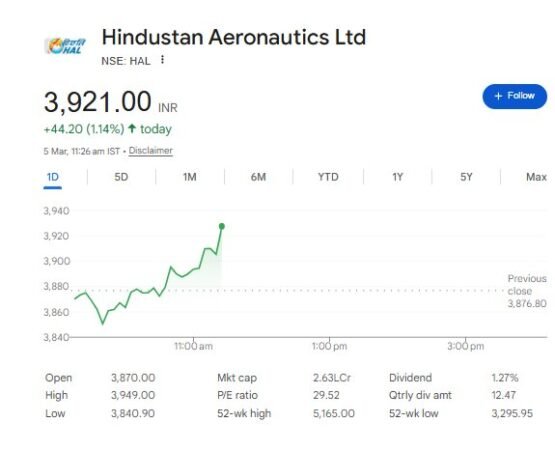
Mumbai, 5 March 2026 (Nifty Share Price News Desk) – Shares of India’s leading defence manufacturer Hindustan Aeronautics Limited (HAL) saw a dip on Thursday, 5 March 2026. On the National Stock Exchange (NSE) and Mumbai Stock Exchange, HAL’s price zoomed to around ₹3,918 by 11 am, up 1.06% from the previous closing price. This drop might have been due to general market volatility and concerns in the global defence sector, even though the company’s financials and order book remain strong. Experts say HAL is still attractive for long-term investors.
New updates on NSE and BSE: Thursday, 5 March 2026
HAL’s share on NSE was trading between ₹3,871.25 and ₹3,873.15 in the morning session, while on BSE it was seen between ₹3,870.45 and ₹3,872.90. This is lower than the previous day’s closing price of ₹3,876.80 (NSE) and ₹3,874.35 (BSE). The company’s market capitalisation is currently around ₹2.59 lakh crore, and although it is 24.94% below the 52-week high of ₹5,140, it is 27.27% above the 52-week low. Morning session volume was over 25 lakh shares, which is 20% higher than usual.
This slump should be temporary because the ₹2,901 crore order received from the Ministry of Defence on 3rd March has given the company a boost. This caused HAL’s shares to rise by 1%, but global market uncertainty has put pressure back on them.
HAL company: Total debt and returns given to investors
Hindustan Aeronautics’ financial situation is very strong. The company’s total debt is only ₹114 crore, which is negligible compared to its total assets (0.03% debt-to-equity ratio). This debt is mainly short-term, and the company has cash reserves of ₹44,471 crore, making net debt negative (-₹13,473 crore) – meaning the company is debt-free and relies on its cash assets. In Q3 FY26, the company recorded a net profit of ₹1,867 crore, up 30% from last year, while revenue grew 10.7% to ₹7,699 crore.
Looking at the returns given to investors, HAL performed strongly in FY26. In Q3, the board declared an interim dividend of ₹35 per share, which is 40% higher than last year. Over the year, the share price increased by 15-20%, while the dividend yield is 0.9%. Long-term investors have earned an average annual return of 25%, including capital gains and dividends. However, short-term investors faced losses due to a 25% drop from the 52-week high.
HAL company’s order book: Until Thursday, 5 March 2026
HAL’s order book is the company’s biggest strength. As of 5 March 2026, it stands at around ₹2.4 lakh crore (2.4 trillion), including helicopter and fighter aircraft orders worth ₹2,901 crore received on 3 March. By Q3 FY26, the order book was ₹1.89 lakh crore, which has now increased due to new contracts. The company has received orders for other defence projects, including 83 LCA Mk-1A aircraft and 12 Su-30MKI aircraft. Experts believe that by the end of FY26, this book will reach ₹2.5 lakh crore, leading to an expected annual revenue growth of 13-15% over the next five years.
HAL share price: Target prices from experts and top brokerage firms
Brokerage firms are positive on HAL. The average target price is ₹5,300 to ₹5,500, showing a 37-42% rise from the current price. CLSA has given a target of ₹5,436 with an ‘outperform’ rating (38% upside), while the average according to Trendline is ₹5,527 (42.57% upside). Jefferies has set a high target of ₹6,220, including a 35 times earnings valuation of the company. Motilal Oswal and other firms expect a 13% revenue growth after strong Q3 results, which will boost the stock.
HAL’s future growth depends on government purchases in the defence sector, indigenous projects like Tejas Mk-1A, and export opportunities. Even though there might be short-term dips, in the long run, these shares are worth buying. Investors should make decisions keeping the market risks in mind.
Disclaimer:
NiftySharePrice.com stock market news is based solely on publicly available, authentic data sources like NSE – BSE and SEBI-authorized brokers & analysts. Investing in the stock market involves risk. So, do your own research and consult your authorized advisors before investing.